
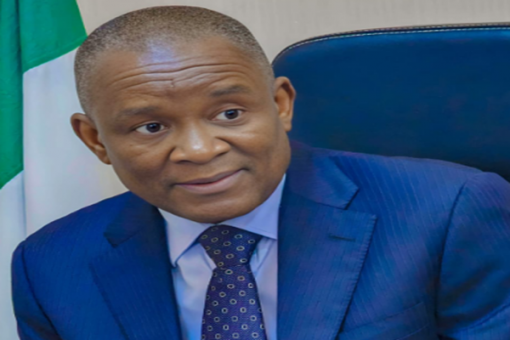
The Minister of State for Industry, Trade, and Investment, Senator John Owan Enoh, has pledged to address the $2.4 billion in unsettled foreign exchange (forex) forward contracts impacting Nigerian manufacturers.
Speaking at the ministry’s inaugural stakeholders’ Town Hall Meeting in Lagos, Senator Enoh assured representatives of the Organized Private Sector (OPS) and the Manufacturers Association of Nigeria (MAN) that he would engage the Central Bank of Nigeria (CBN) to resolve the issue.
Unsettled Forex Contracts and Industry Concerns
The unsettled forex forward contracts, which serve as a hedge against exchange rate volatility, have created significant financial challenges for manufacturers.
- MAN’s Director-General, Segun Ajayi-Kadir, emphasized that honoring these contracts is essential for restoring market confidence and attracting Foreign Direct Investment (FDI).
- Ajayi-Kadir stated that many manufacturers had obtained bank loans to finance operations tied to these forex contracts, which were backed by compliant trade documents.
The CBN had previously cited ongoing investigations by the Economic and Financial Crimes Commission (EFCC) as the reason for its inability to honor the contracts, though no infractions have been officially communicated to the affected manufacturers.
Key Recommendations from MAN
In addition to addressing the forex issue, MAN urged the government to:
- Enforce standards for imported goods.
- Ensure government institutions patronize locally produced goods.
- Overhaul educational curricula to prioritize skill acquisition.
- Boost raw material development and ease of doing business.
- Tackle insecurity in regions where industrial operations have been hindered, such as the Northeast.
Ajayi-Kadir highlighted the potential of the manufacturing sector to generate $6.72 billion in foreign exchange annually and significantly increase non-oil exports.
Formation of an Industrial Revolution Work Group
To bolster collaboration and address systemic challenges, Senator Enoh announced the establishment of an Industrial Revolution Work Group, co-chaired by himself and the MAN President. The group will consist of key stakeholders across the industrial sector and will convene quarterly to evaluate and implement recommendations from stakeholder engagements.
The Minister emphasized the unique role of manufacturing in driving economic development, stating, “No economy has developed without the formidable role of manufacturing.”
OPS Commitment and Collaboration
The Chairman of the Organized Private Sector in Nigeria (OPSN), Otunba Francis Meshioye, affirmed the sector’s readiness to work collaboratively with the ministry. He called for sustained dialogue and policy reassessment to ensure the industrial sector fulfills its role as a catalyst for technological advancement, job creation, and economic growth.
Looking Ahead
The resolution of unsettled forex contracts and the implementation of targeted industrial policies could unlock significant opportunities for Nigeria’s manufacturing sector, contributing to broader economic stability and growth.